

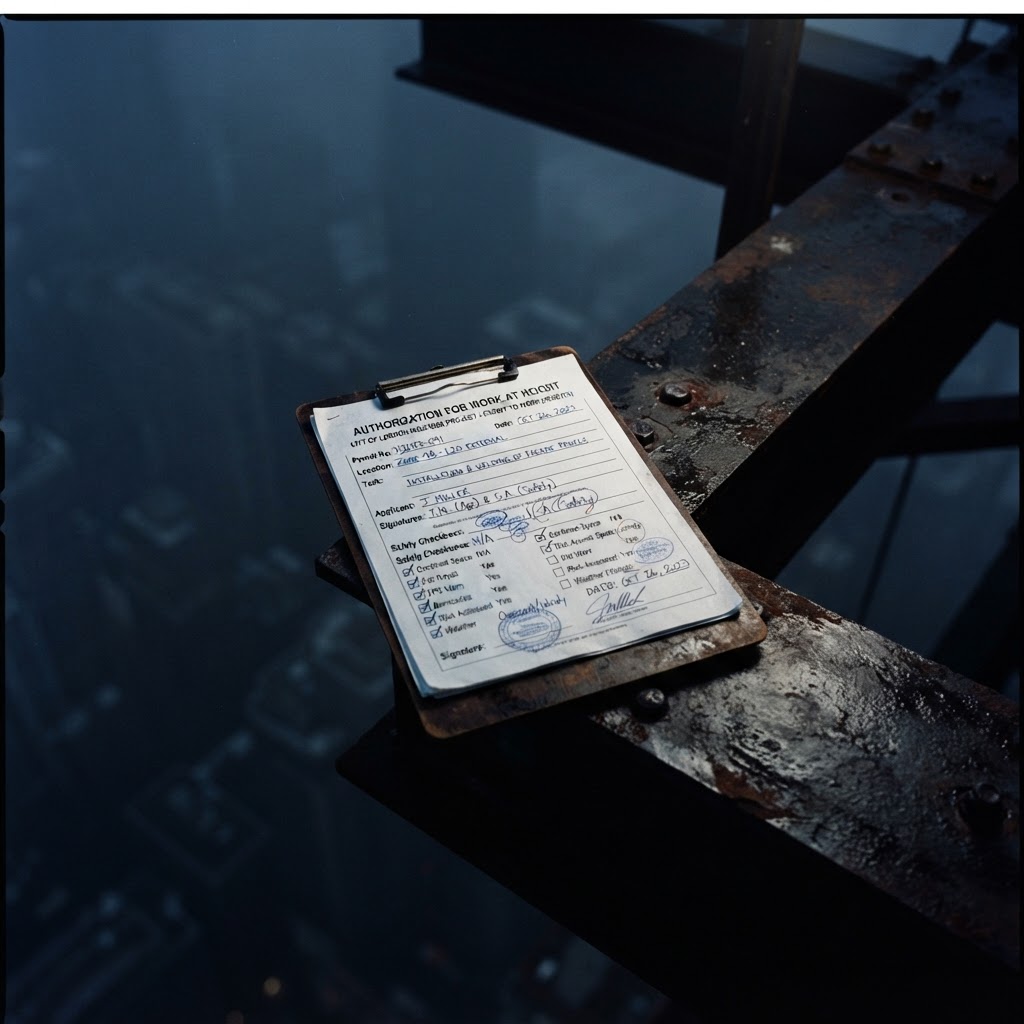
The Permit That Looked Perfect
Not the obvious kind of risk — the kind where someone skips a step or forgets a form.
I'm talking about the other kind. The kind where everything is filled out correctly. Every field completed. Every signature in place. Every piece of evidence attached. The permit looks perfect.
And the work is still not safe to start.
I've spent enough time around safety systems to know that this is the gap nobody talks about. Not the gap between doing the paperwork and not doing it. The gap between completing the paperwork and controlling the risk.
What the form doesn't tell you
A permit form asks: what activity are you doing? Hot work. Confined space. Working at height. Lifting operation. It asks: do you have controls in place? Yes. Evidence attached? Yes. Competent person assigned? Yes. Sign here.
Here's what it doesn't ask: how much energy is present, and how strong are the controls you're relying on?
Two hot work permits can look identical on paper. Same form. Same checkboxes. Same evidence folder. One involves welding near a sealed, purged vessel where the energy is contained. The other involves welding near an open flammable atmosphere where the only thing between the worker and a flash fire is a pair of flame-resistant coveralls — PPE. The last line of defence. The weakest control tier there is.
Both permits would pass a paperwork check. Only one of them is actually controlled.
That's not a paperwork problem. That's a thinking problem.
The shift that changes everything
Serious injuries and fatalities are, almost without exception, the result of an uncontrolled release of energy. Kinetic. Gravitational. Electrical. Thermal. Chemical. Pressurised. The type and magnitude of energy present in a task predicts the outcome far more reliably than the category of the task.
This isn't new knowledge. It's been established in safety science for decades. But most digital permit systems haven't caught up. They still classify risk by activity type — hot work, confined space, working at height — as if the label tells you everything you need to know. It doesn't. It tells you the category of hazard. It doesn't tell you the magnitude of exposure.
And then there's the question of controls. The widely-recognised Hierarchy of Controls ranks interventions by real-world effectiveness: eliminating or isolating the energy source is strongest. Engineering barriers that physically separate people from the hazard are next. Administrative procedures are weaker. PPE is the last line — relied upon only when everything above it has already been applied.
A task that only has PPE in place, however well documented, is in a fundamentally weaker position than one where the energy source has been isolated. A permit system that treats both the same — that says "evidence attached, control exists, PASS" — is not evaluating safety. It's evaluating paperwork.
What it looks like when the thinking changes
When you start classifying by energy and weighting by control strength, something shifts. The conversation moves from "is the form complete?" to "is the exposure controlled?" And that's the only question that actually matters before you sign a permit.
A high-energy task where the only controls are administrative procedures and PPE? That's not a PASS. That's a conversation. A conversation about whether you can engineer a barrier, isolate the source, or reduce the energy before anyone goes near it.
A high-energy task with strong engineering controls, verified by someone who didn't install them, backed by a rescue plan and a human performance check? That might be a PASS. Not because the paperwork is complete — but because the exposure is genuinely controlled.
The permit that looks perfect is not the same as the work that is safe to start.
One action before your next permit: look at the energy present — not the activity category — and ask whether the controls you're relying on are strong enough for that energy. Not whether they exist. Whether they're strong enough.
It is available to you. Not after you upgrade your entire safety system. Now.