

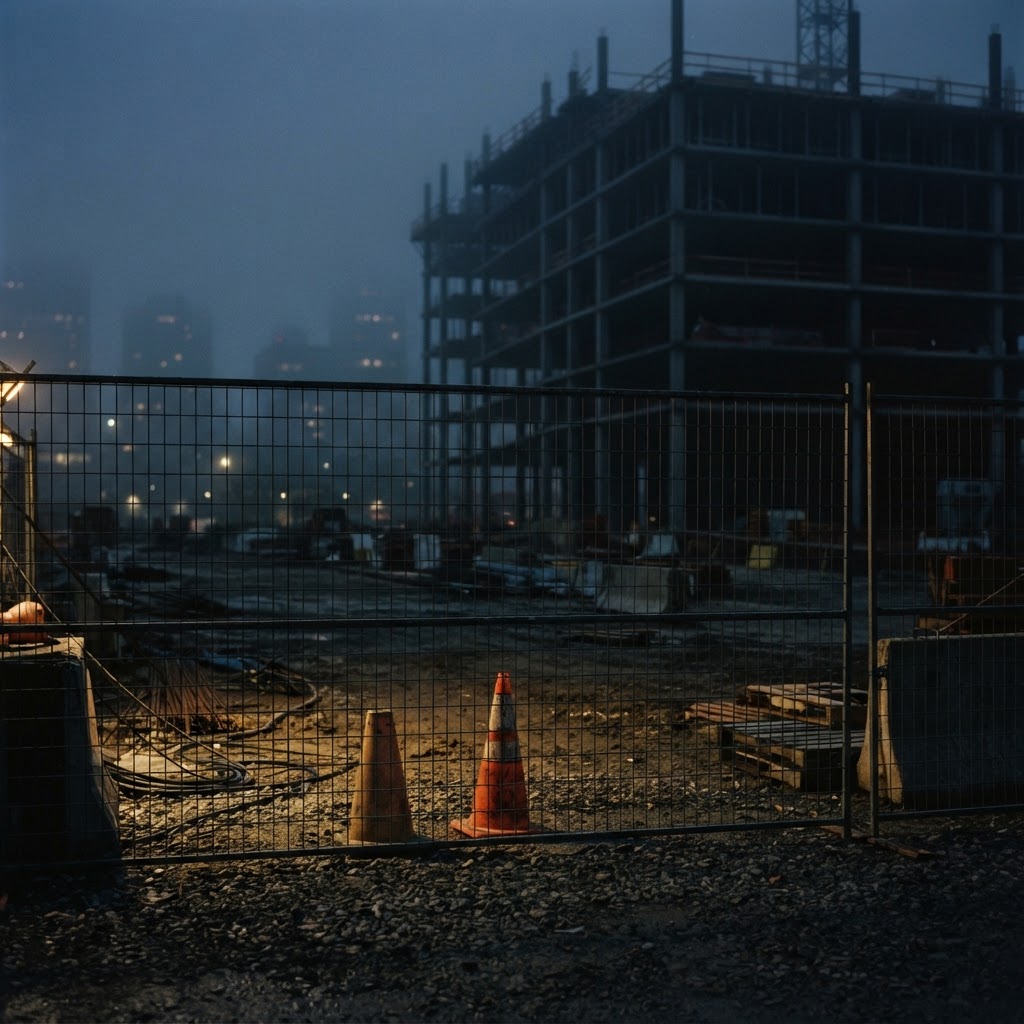
The Moment Everyone Freezes
Not the dramatic kind of freeze — the kind where someone sees a hazard and stops.
I'm talking about the quieter kind. The kind where a worker senses that something isn't right — a smell in a confined space, a vibration in a scaffold, a change in the wind during a lift — and for a split second, they hesitate. Not because they don't know something is wrong. Because they're not sure they're allowed to do anything about it.
That hesitation is the most dangerous moment on any site. And almost no safety system is built to handle it.
The gap between awareness and authority
Most safety training focuses on awareness. Teach workers to recognise hazards. Teach them to speak up. Teach them that safety is everyone's responsibility.
Then send them back to a permit system that treats work as binary: not yet started, or done. There is no state for "we've started, and we need to stop." There is no button that says "halt this." There is no mechanism that says "your instinct is valid — use it, and the system will back you."
We tell people they have the right to stop work. Then we give them systems that don't actually let them do it.
That's not an awareness gap. That's an authority gap. And it's the difference between a safety culture that works on paper and one that works in the field.
What happens when the system catches up
When a worker has the explicit, system-backed authority to halt an active permit — not just the training, but the actual mechanism — something changes. The hesitation shrinks. The gap between "something feels wrong" and "work has stopped" narrows from minutes to seconds.
And here's the part that surprises people: the cost of stopping is almost always lower than the cost of not stopping. A permit that's paused, re-evaluated, and re-issued with better information is a permit that worked. A permit that continued because nobody felt they could stop it is an incident waiting to be investigated.
The strongest safety signal on any site isn't the number of permits completed without incident. It's the number of times work was stopped early enough to prevent one. That's not a failure metric. That's a leading indicator. It tells you your people are paying attention — and that they trust the system enough to act on what they see.
The cultural signal encoded in software
When a permit system has a Stop Work state — when any worker, including a contractor, can trigger it, when the permit automatically routes back for re-evaluation, when the stop is logged not as a failure but as a positive safety event — that system is doing something most safety software doesn't do. It's encoding a cultural value into the workflow.
It's saying: stopping is not a disruption. Stopping is the system working exactly as intended.
The most powerful safety tool on any site is not a form, a barrier, or a checklist. It is the explicit, unambiguous right of any worker to halt work — and a system that backs them when they do.
One question for your next site walk: ask your team — not your supervisors, your team — what happens if they stop work because something feels wrong. If the answer is "I'm not sure," that's not a training problem. That's a system problem.
It is available to you. Not after someone gets hurt. Now.